Is cracking normal in a new Tarneit home, or is it a defect?
"That is just settlement" is sometimes true and sometimes an answer that ends a conversation the builder does not want to have. The standard settles it.
Published 4 September 2026 · 8 min read · Owner Inspections Pty Ltd
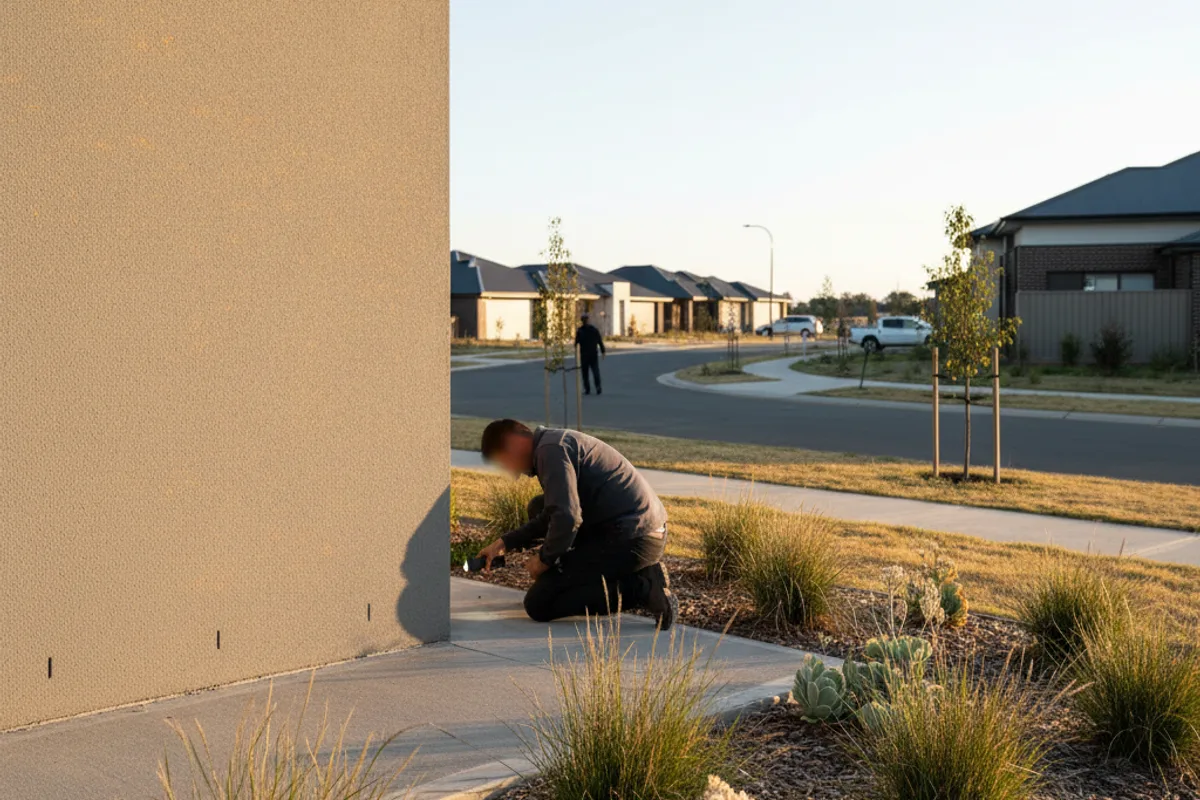
Cracking is the single most common reason a Tarneit owner calls an inspector, and the single most common answer they have already been given is that it is normal settlement. Sometimes that answer is correct. The problem is that it is also the easiest thing to say, and it is unfalsifiable unless somebody measures.
Why Wyndham sees more of it
Much of Melbourne’s western corridor sits on reactive clay, often on engineered fill from the original subdivision earthworks. Reactive clay changes volume with moisture: it swells when wet and shrinks when it dries. That movement is seasonal and it never entirely stops.
A house on reactive soil is therefore designed to move a little. Articulation joints, the engineered slab and the masonry detailing all exist to absorb that movement without damage. Cracking becomes a defect when it exceeds what the design was meant to tolerate, or when it indicates the design is not doing its job.
How Victoria actually classifies a crack
The Guide to Standards and Tolerances is the reference used in Victorian domestic building disputes. It borrows a damage classification based on crack width, which is why an inspector will always measure rather than describe.
| Category | Typical crack width | What it usually means |
|---|---|---|
| 0 | Under 0.1 mm | Hairline. Not considered damage. |
| 1 | Up to 1 mm | Fine cracks, normally cosmetic and filled at maintenance. |
| 2 | Up to 5 mm | Noticeable. Repairable by filling, may recur if the cause is not addressed. |
| 3 | 5 to 15 mm | Requires opening up and patching, may need some brickwork replaced. |
| 4 | 15 to 25 mm | Extensive repair, wall sections may need replacing. |
The patterns that concern an inspector
- Diagonal cracks running from the corners of windows and doors, which follow the direction of differential movement
- Stepped cracking through mortar joints in brickwork, especially near a corner or a change in wall height
- Cracks that are wider at the top than the bottom, or the reverse, indicating rotation rather than shrinkage
- The same crack reopening after it has been filled, which means the cause was never addressed
- Cracking accompanied by doors and windows that have started to bind, or floors that have gone out of level
What we look at besides the crack
On a Tarneit property the investigation almost always goes to moisture management around the slab, because that is what drives reactive movement. That means checking finished ground levels against the slab edge, whether stormwater actually reaches the legal point of discharge, whether downpipes discharge onto the ground beside a footing, whether garden beds and irrigation sit hard against the wall, and whether paving has been laid over the required slab-edge clearance.
Those five things are the usual mechanism. They are also, helpfully, the cheapest things to correct.
Where the builder’s responsibility sits
Victorian domestic building work carries statutory warranties, with structural obligations running six years from completion and a ten-year limitation period for building actions. Within that period, cracking caused by defective work or a non-compliant design is the builder’s to rectify. Cracking caused by an owner’s later landscaping, or by failing to maintain drainage, generally is not.
That distinction is exactly why an independent report matters. It separates what the builder built from what happened afterwards, with photographs and measurements attached to a date.